Key Contributions
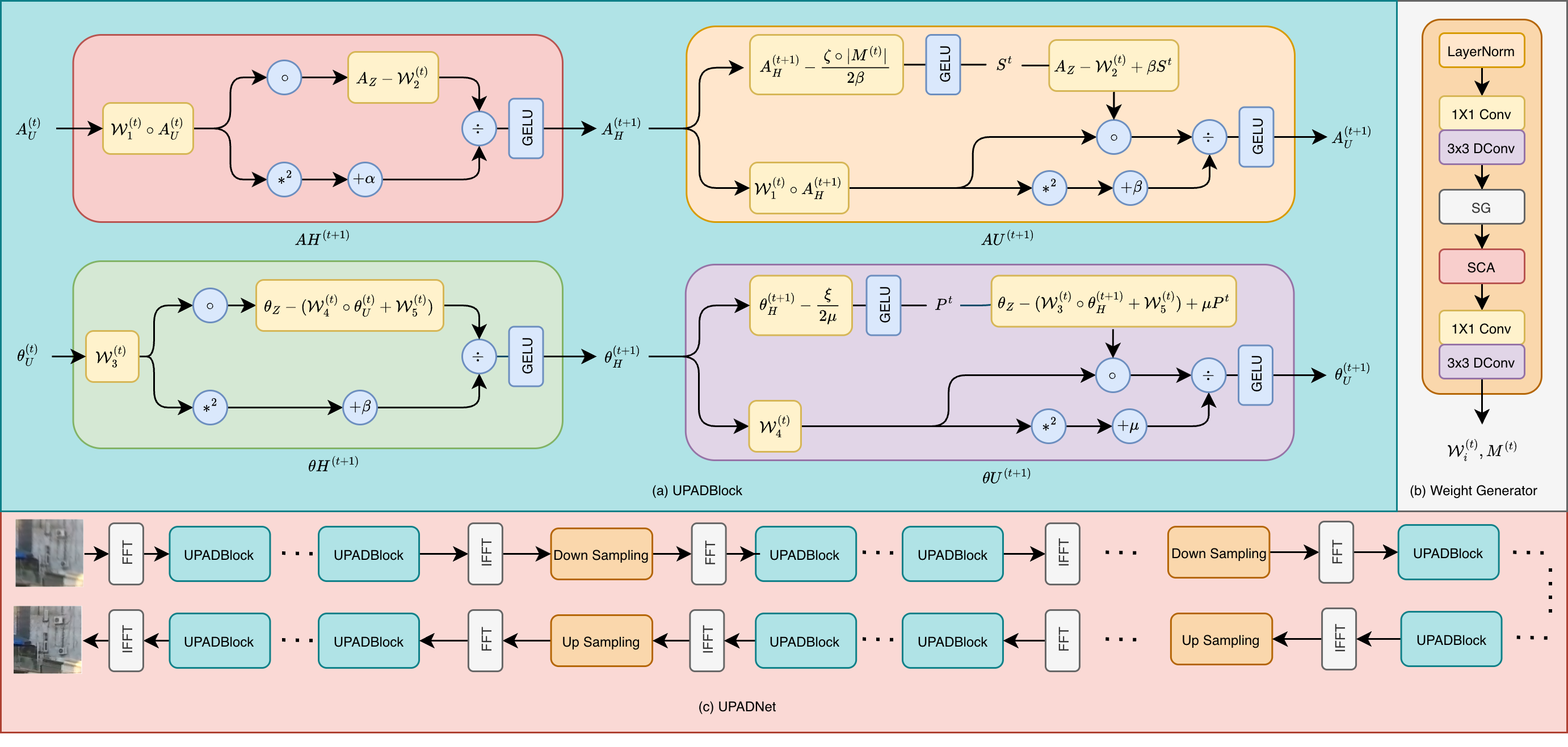
This paper makes three primary contributions to blind image deblurring. First, it challenges the conventional practice of treating frequency-domain information implicitly by explicitly modeling the phase and amplitude components of blurred images, highlighting the critical role of phase in preserving structural details during restoration. Second, it introduces a statistically grounded formulation by deriving Linear Minimum Mean Squared Error (LMMSE) estimators for both amplitude and phase, providing a principled alternative to conventional Fourier-domain approximations and demonstrating improved estimation accuracy under noise. Third, the proposed optimization framework is transformed into UPADNet, a model-driven deep unrolled architecture that learns the parameters of the iterative reconstruction process directly from data while preserving interpretability. The resulting framework effectively combines physical modeling, statistical estimation, and deep learning, achieving state-of-the-art deblurring performance with strong robustness to noise, real-world degradations, and limited training data, demonstrating improved generalization compared with existing deep and unrolled methods.
UPADNet
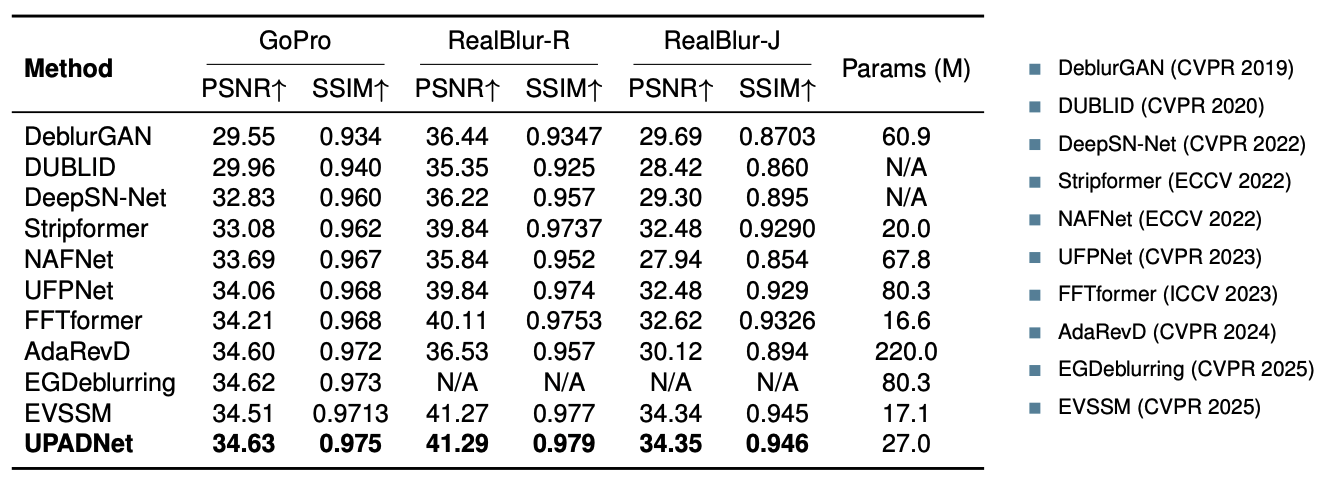
Results
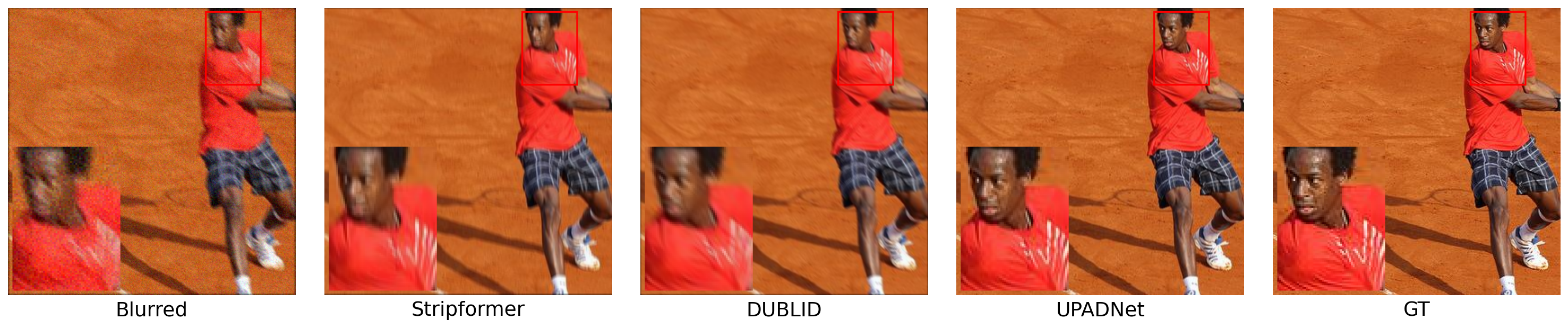
Results in nosiy condition
Published Paper
S. Malek et al., "Leveraging Phase Information to Boost Unrolled Network Learning for Image Deblurring". [ECCV2026]

